A wrong CV axle can stop a repair and create costly returns. Understanding how it works is only the first step toward choosing the correct replacement.
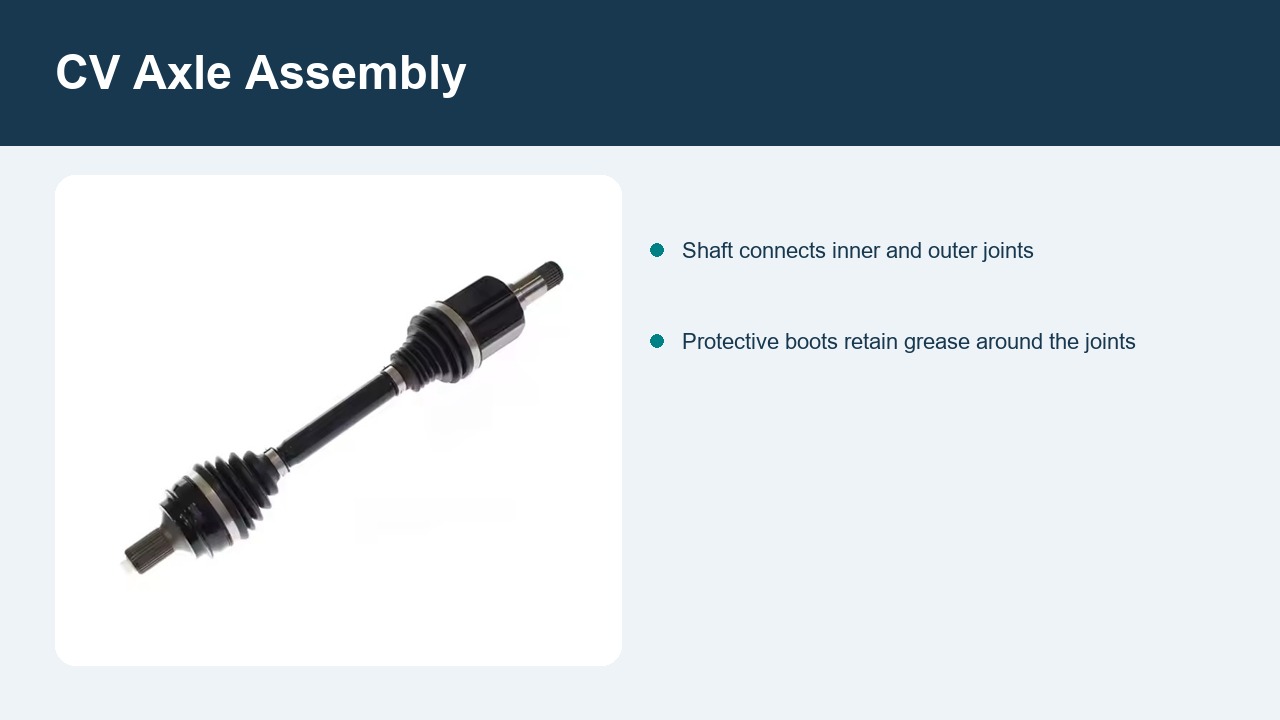
A CV axle, or constant velocity axle, transfers driving torque to a vehicle’s wheels while allowing the suspension and, where applicable, steering to move. It usually includes a shaft, inner and outer CV joints, and protective boots. Correct replacements must match the vehicle and installation position.
For a repair shop, the main question may be whether the axle has failed. For an importer or distributor, it is also whether a replacement can be identified and ordered without a fitment mistake. Both questions need clear answers.
What Does a CV Axle Do?
A vehicle needs to deliver power to wheels that change position as it moves. A rigid connection would struggle with suspension movement and steering angles.
A CV axle transfers torque through joints that work at changing angles. It helps driven wheels receive power as the suspension travels and, on steering axles, the wheels turn. CV axles are common in front-wheel-drive and all-wheel-drive vehicles and also appear in some rear-wheel-drive layouts.
Power transfer without a fixed angle
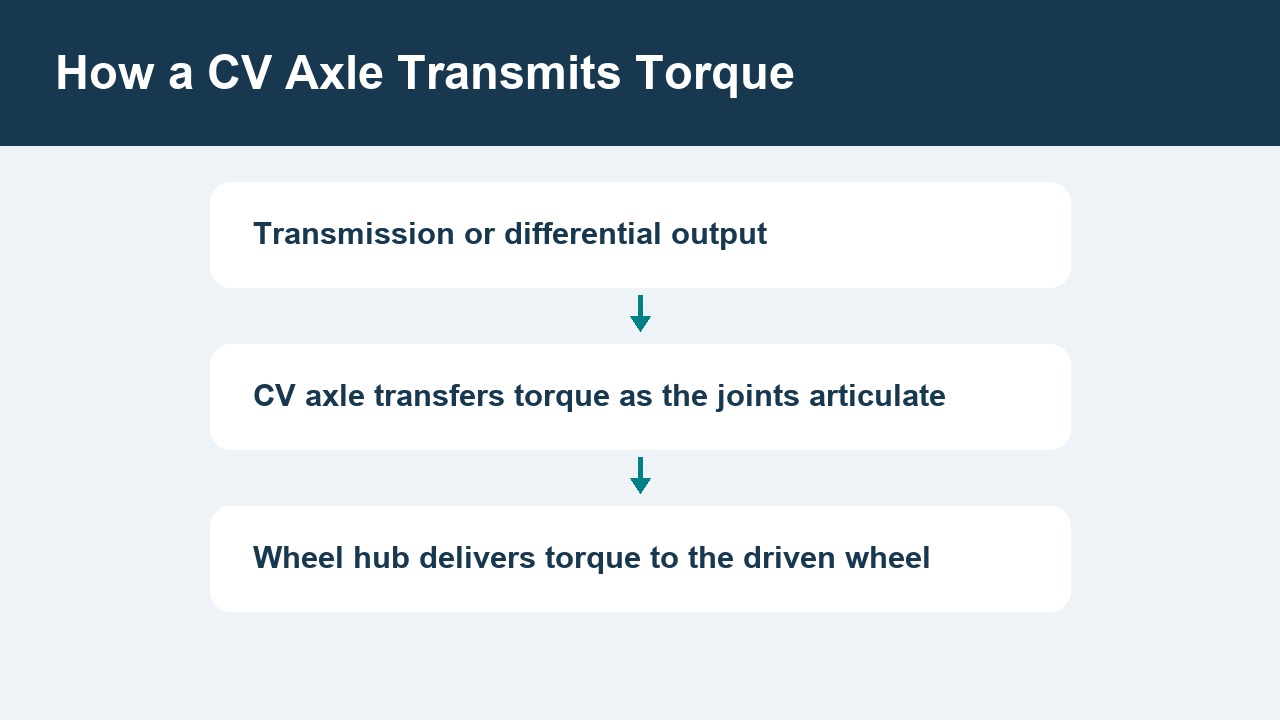
The engine produces power, but the drivetrain must transmit it to the driven wheels. A CV axle connects a transmission or differential output to a wheel-side hub assembly, depending on the vehicle layout. Its CV joints accommodate angles between those components while transmitting torque.
The term constant velocity describes the joint’s ability to transmit rotation without the speed fluctuations associated with a simple universal joint operating at an angle. This does not mean that the car travels at a constant road speed. It describes how the joint handles rotation.
CV axles are often called half shafts, axle shafts, or driveshafts in parts catalogs. The word driveshaft can also refer to a different component, such as a propeller shaft connecting a transmission and rear differential. We recommend checking the product drawing and application data rather than relying on the name alone.
The axle arrangement changes with the drivetrain. A front-wheel-drive vehicle normally uses two front half shafts. An all-wheel-drive car may also use rear half shafts. A rear-wheel-drive vehicle with independent rear suspension can use CV-jointed rear shafts. The exact number and design depend on the vehicle, so do not assume every car has the same layout.
What Are the Main Parts of a CV Axle?
Two replacement axles may look similar in a product photo. Small differences in the joints, splines, length, or attachments can still prevent installation.
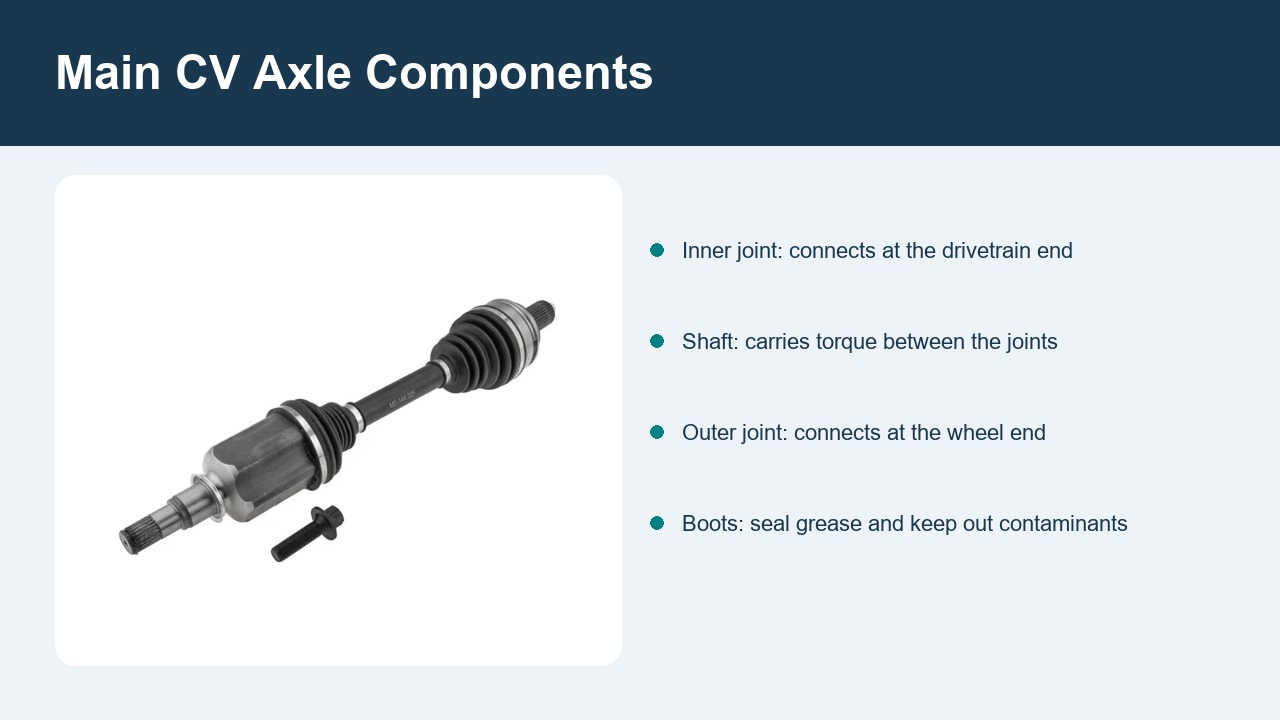
A typical complete CV axle contains an axle shaft, an inner CV joint, an outer CV joint, protective boots, and associated fasteners or retention hardware. Individual designs vary, so buyers should confirm what the supplied assembly includes.
Inner and outer joints have different jobs
The inner CV joint works near the transmission or differential. Many inner-joint designs allow the effective axle length to change slightly as the suspension moves. This is called plunging. The outer CV joint, near the wheel hub, typically accommodates the larger steering angle on a driven steering axle. The actual joint construction depends on the application. GKN Automotive describes these different joint roles in its CV joint technology guide.
The boots protect the grease and working surfaces inside the joints. When a boot splits or loses its seal, grease may escape and water or dirt may enter. A damaged boot does not automatically prove that the whole axle has failed, but it does call for inspection. GKN explains why precise boot fit matters in its driveshaft boot overview.
| Component | Main role | Detail to confirm when sourcing |
|---|---|---|
| Axle shaft | Carries torque between joints | Overall design and relevant length measurements |
| Inner CV joint | Transmits torque while accommodating drivetrain movement | Connection type and joint design |
| Outer CV joint | Transmits torque to the wheel-side connection | Splines, hub connection, and retention method |
| Protective boots | Keep lubricant in and contaminants out | Boot design, clamps, and condition |
| Fasteners or retaining parts | Secure the assembly where specified | Whether the correct hardware is included |
A distributor should also check whether a listing is for a complete axle, a replacement CV joint, or a boot kit. Those are not interchangeable purchasing descriptions. A correct part number with an unclear package description can still lead to an incomplete order.
What Are the Signs of a Bad CV Axle?
A clicking sound or visible grease may point toward a CV joint problem. But replacing an axle without checking the cause can waste parts and labor.
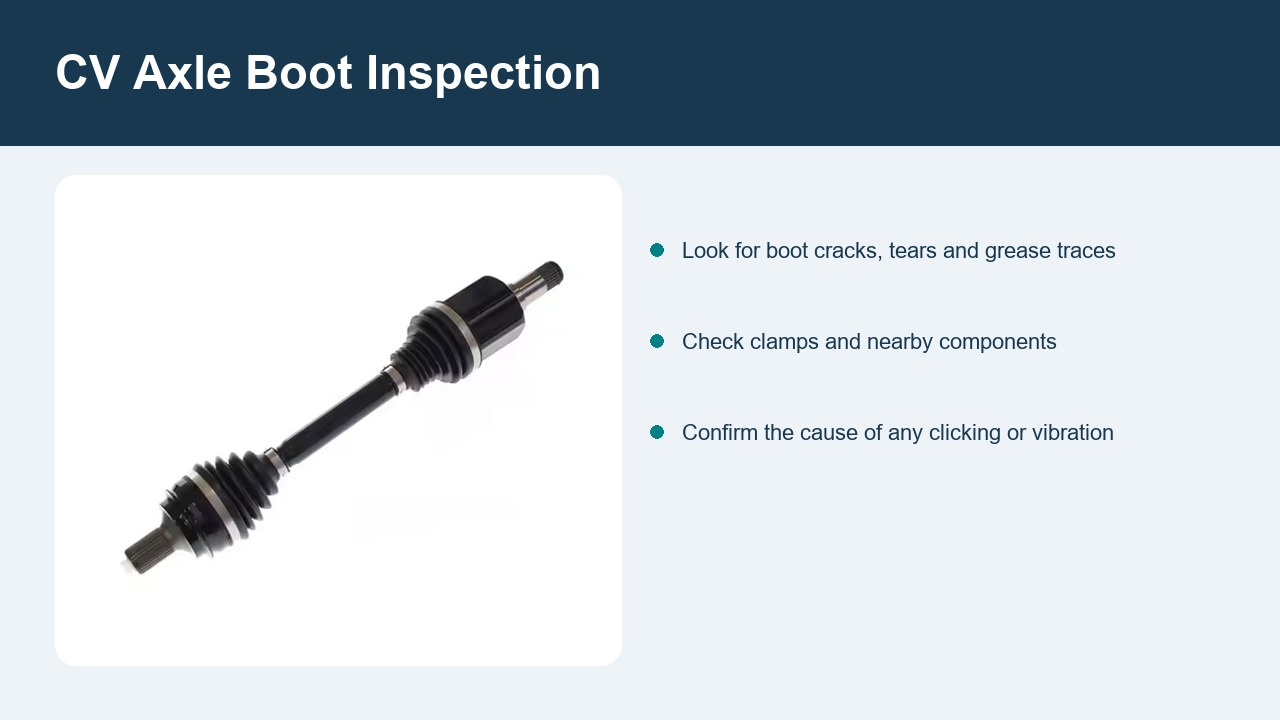
Common warning signs include clicking during turns, grease around a damaged joint boot, clunking during load changes, and some drivetrain vibrations. None of these symptoms alone confirms CV axle failure; a qualified technician should inspect the vehicle and rule out other causes.
Match the symptom to the possible cause
Clicking or popping during a low-speed turn can be associated with an outer CV joint, particularly when the sound changes with steering angle or vehicle load. A clunk during acceleration or deceleration may point toward driveline movement, but other mounts or drivetrain components can produce similar noises. Vibration is even less specific because wheels, tires, suspension parts, and other rotating components can cause it.
A torn boot is an important inspection clue. If grease has escaped, the joint may be running with poor lubrication. Moisture or road debris can also damage its internal surfaces. A technician needs to assess the condition of the boot, joint, surrounding area, and vehicle operation before deciding on the repair.
For a parts supplier, the diagnosis affects what should be quoted. One workshop may need a complete axle assembly. Another may need only a compatible joint or boot kit, if that repair is appropriate and the needed components are available.
Before accepting a return described simply as “bad axle,” ask for clear evidence: the part reference, installation side, vehicle details, photographs, and an explanation of the symptom. This does not replace the supplier’s warranty process, but it can help distinguish a catalog error from a product issue or unrelated vehicle fault.
How Do You Choose the Correct CV Axle for a European Vehicle?
A matching model name is not always enough. Different drivetrains, installation positions, and production versions can require different CV axles.
To identify the correct CV axle, check the OE reference, VIN or complete vehicle details, drivetrain configuration, installation position, and connection specifications. Compare shaft length, spline count, and joint interfaces where the application data requires them.
Why vehicle details matter
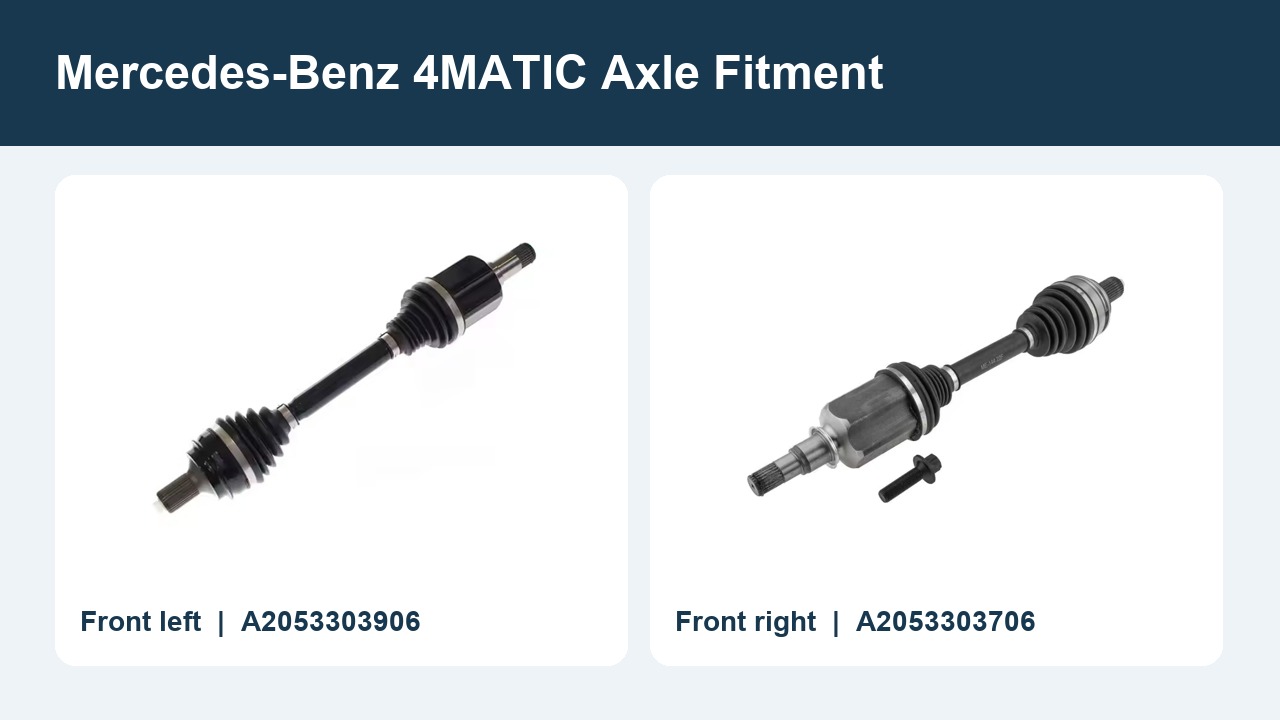
Consider two replacement axles for the same vehicle family. One may be designed for a different model year, transmission arrangement, front axle configuration, or side of the vehicle. A similar shaft shape does not establish interchangeability. A part number shown on a product page is a useful starting point, not permission to ignore other application details.
Carpal currently lists a front-left CV axle under reference A2053303906 for specified Mercedes-Benz W205 4MATIC applications. The catalog also has a separate front-right CV axle listing under reference A2053303706. These are examples of separate product listings, not a statement that either part fits every W205 or every C300. Their exact suitability must be checked for the target vehicle.
A useful sourcing request contains the following information:
| Identification field | Why it matters |
|---|---|
| VIN or verified OE number | Narrows down the correct original application |
| Vehicle make, model, and chassis code | Separates closely related vehicle generations |
| Engine, transmission, and drivetrain | Helps identify variant-specific shaft designs |
| Production year or date | Helps account for changes during a model’s life |
| Front or rear; left or right | Prevents ordering the wrong installation position |
| Photos and connection details | Helps resolve uncertain catalog matches |
A cross-reference number should be checked against the exact vehicle application. It may reflect a documented supersession or an alternative catalog reference, but a number appearing alongside another is not enough to prove universal interchangeability. When comparing replacement assemblies, confirm the specified shaft length, spline details, hub and differential connections, and any application-specific sensor ring or mounting features. If data is incomplete, ask the supplier to verify the fitment before confirming the order.
What Should Wholesalers Check Before Ordering CV Axles?
Bulk orders multiply small mistakes. One missing fitment field can turn a routine replenishment purchase into repeated returns across several workshops.
Wholesale buyers should verify the OE and vehicle application data, required quantities, product scope, packaging, stock availability, lead time, and warranty terms for each CV axle reference. A structured SKU-level request reduces confusion between visually similar parts.
Build a checkable parts request
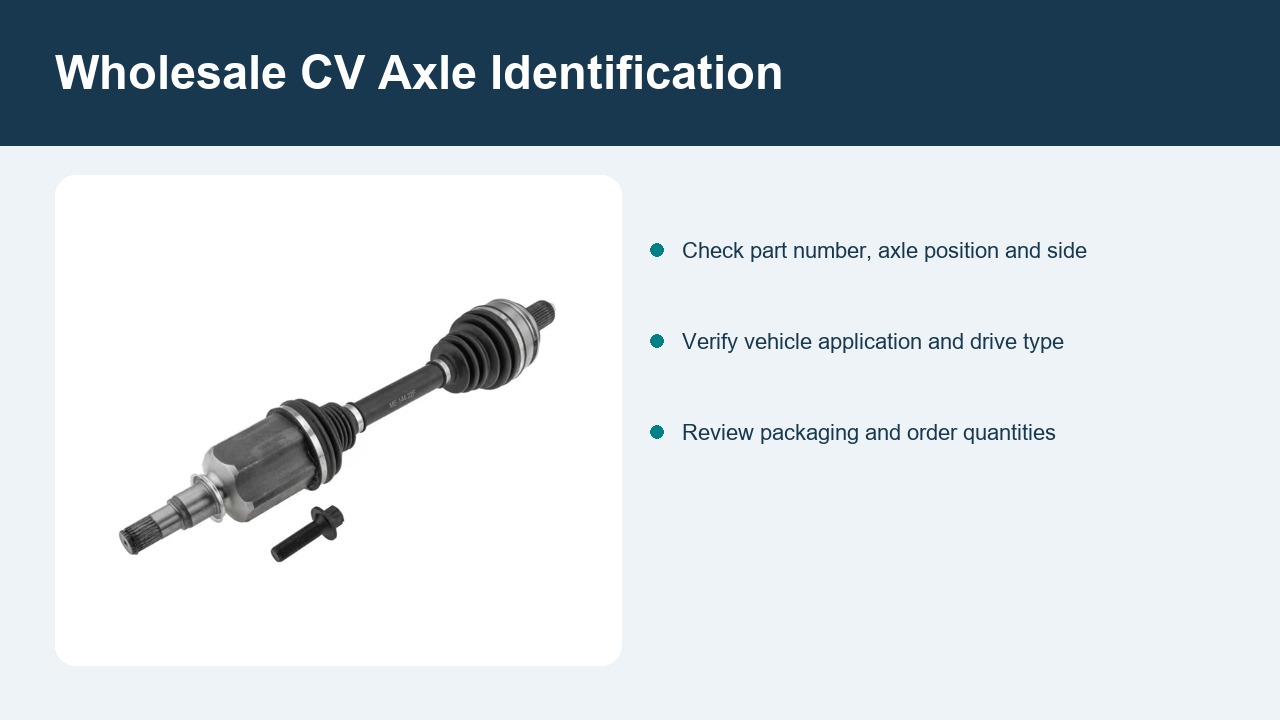
Start with the parts list, not a general request such as “Mercedes axle price.” Each line should include the requested reference, supported application information, side, quantity, and any known special features. Ask the supplier to flag mismatches or missing fields before issuing the final quotation.
Next, confirm the scope of supply. A complete CV axle and a joint kit may be priced differently and may contain different hardware. Check whether relevant retaining rings, axle nuts, clamps, or other fitting parts are included; do not assume that one manufacturer’s kit contents apply to another. For distributors, the sales catalog should make the contents clear so workshops know exactly what they are buying.
Finally, discuss commercial requirements separately for each part number. Stock may vary by reference. Minimum quantities and packing methods may also differ. Buyers who sell under their own brand should ask about label data, carton design, batch traceability, and any documentation required in their markets rather than assuming a standard private-label arrangement applies to all products.
At Carpal, buyers can browse the CV axle product category and submit an inquiry with OE references, vehicle details, and quantities. We recommend requesting fitment confirmation before committing to a mixed-SKU order. This approach is more useful than a quote based only on a broad vehicle-model name.
Should You Replace a CV Joint or a Complete CV Axle?
The cheapest-looking repair is not always the right repair. The condition of the shaft and the availability of compatible parts both matter.
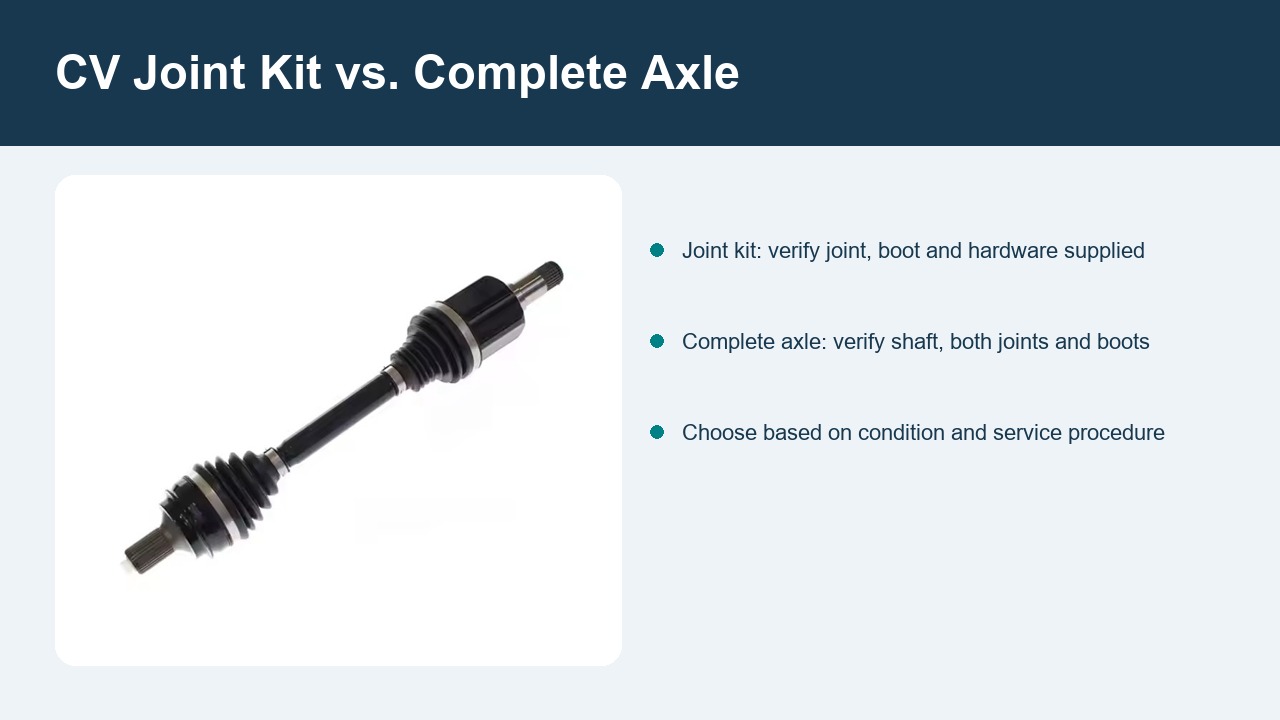
A CV joint or boot repair may be suitable when the remaining assembly is serviceable and the correct kit is available. A complete CV axle replacement may be more appropriate when joints are worn, the shaft is damaged, or a verified assembly offers a better repair option.
Compare repair scope before choosing parts
A damaged boot discovered early may allow the workshop to inspect the joint and consider replacing the boot and specified lubricant. If contaminants entered the joint or its internal surfaces show wear, simply installing a new boot may not solve the problem. The technician must follow the applicable service guidance and inspect related parts.
A separate CV joint kit can make sense when the exact joint is available and the shaft can be reused safely. A complete axle assembly may reduce the need to dismantle and rebuild an individual joint, but it still must match the correct vehicle configuration. The actual labor, cost, and availability vary by vehicle and market.
For buyers, the important distinction is repair outcome versus product name. Do not order a CV joint kit when the workshop specifically requires a complete shaft assembly. Do not assume a complete axle is necessary when only a boot issue has been confirmed. Keep product catalog labels precise and request confirmation whenever the repair scope is uncertain.
This distinction also helps inventory planning. A distributor may stock complete assemblies for common vehicle applications while sourcing specialized repair kits as needed. The right approach depends on customer demand, repair practices, and dependable application data, not a universal rule for every vehicle.
Conclusion
A CV axle transfers torque through changing angles. Correct replacement starts with diagnosis, then verified OE references, vehicle configuration, installation position, and clear ordering details.