
An overheating warning can turn a routine drive into an expensive engine repair. Guessing which cooling part failed may waste time while the real problem continues.
Car overheating can result from low coolant, leaks, a thermostat or water-pump fault, restricted cooling flow, or inadequate radiator airflow. Pull over safely, shut off the engine, and never open a hot pressurized coolant cap. The cause must be diagnosed before deciding whether it is safe to drive again.

I treat overheating as a system-level problem. A workshop must first protect the vehicle and identify the fault. A parts buyer must then match the correct replacement, not simply order the first part associated with a high temperature reading.
What Should You Do Immediately When a Car Overheats?
Steam from the engine bay or a red temperature warning calls for action. Driving farther to test the problem can turn a cooling fault into major damage.
Find a safe place to stop as soon as possible, switch off the engine, and follow the vehicle manufacturer’s guidance. Keep clear of steam and hot surfaces. Never loosen a hot radiator or expansion-tank cap, and arrange professional inspection or recovery when overheating is serious.

Protect people before diagnosing the car
The first priority is a safe stop, not a parts decision. Move out of traffic where it is safe to do so, turn the engine off, and avoid touching potentially hot components. Cooling systems can remain pressurized long after the engine has stopped. Opening a cap too early can release hot coolant and steam and cause severe burns. I would not tell a driver to remove a cap simply because the dashboard display has moved away from the red zone.
If the vehicle is showing a serious overheating warning, losing power, or releasing steam, a tow or qualified roadside service is usually a safer plan than trying repeated starts. Do not remove the radiator cap or pour cold water onto a hot engine. If it can be done without delaying a safe stop, turning off the air conditioning and using the cabin heater may briefly reduce heat load, but it is not a reason to continue driving or postpone stopping. Local road conditions and the vehicle handbook may affect the immediate response, but neither makes it sensible to continue driving a known overheating engine.
The Firestone guide to an overheating car covers warning signs, safe stopping, and the risk of continued operation. I would treat its owner-facing advice as general guidance rather than a substitute for the vehicle’s own emergency procedure.
What information is useful for the workshop?
Once it is safe, record the warning shown, whether steam or a coolant smell was present, the driving conditions, and any recent cooling-system work. Useful clues include overheating mainly at idle versus highway speeds, coolant loss without a visible puddle, weak cabin heat, and a heater that suddenly blows cold; none identifies the failed part on its own. A photo of the warning message may be helpful. Do not reach into hot or moving engine parts to gather evidence. These observations can help the technician reproduce the complaint without guessing which component caused it.
For a distributor, this incident report also helps prevent an inaccurate rush order. The correct first question is whether the engine is truly overheating and where the fault lies, not whether the buyer wants a thermostat or water pump shipped immediately.
What Are the Most Common Causes of Engine Overheating?
Several cooling faults produce the same temperature warning. Replacing a single part because it is common on one model can leave another fault untouched.
Common causes include low coolant from leakage, a thermostat that restricts flow, a failing water pump, a faulty radiator fan, blocked airflow, an ineffective radiator, and trapped air. Some engines also overheat due to combustion or lubrication problems. Diagnosis must distinguish these causes.

Think about fluid, flow, and airflow
Engine cooling depends on moving heat away from the engine and releasing it to the air. Coolant travels through the engine and cooling circuit; the pump helps circulate it, while a thermostat regulates the route on many systems. The radiator transfers heat to outside air, supported by a fan when vehicle speed does not provide enough airflow. The actual arrangement can include electric pumps, several coolant circuits, or electronic controls.
I find it useful to separate failures into three groups. Fluid loss means the system may not have enough coolant to manage heat. Flow restriction means circulation or routing is insufficient despite coolant being present. Airflow or heat-exchange problems mean the radiator cannot release heat efficiently. These groups overlap, but they discourage the assumption that every high temperature reading points to the same component.
| Possible cause | Useful clue | Why it is not a final diagnosis |
|---|---|---|
| Coolant leak | Falling level or visible residue | The leaking point may be a hose, seal, tank, radiator, or other item |
| Thermostat problem | Abnormal warm-up or temperature control | Sensors and circulation faults can look similar |
| Water pump problem | Cooling loss, noise, or leakage in some designs | Other restrictions can also reduce circulation |
| Fan or airflow problem | Heating issues in slow traffic or at idle | Fan commands, wiring, condenser blockage, and other faults need checking |
| Radiator restriction | Poor heat rejection | Air pockets and pump problems can produce similar observations |
A practical clue-to-test map can help a workshop choose the next inspection without jumping to a parts order:
- Hot mainly in traffic or at idle: check fan request, actual fan operation, airflow, and possible radiator restriction; this does not prove fan failure.
- Hot at road speed or under load: consider low coolant, circulation, combustion-gas intrusion, heat-exchanger performance, and other engine-specific conditions.
- Coolant disappears without obvious external residue: investigate pressure loss and possible internal leakage rather than assuming a hose is leaking.
- Overheats after cooling-system service: verify the correct filling and bleed procedure, coolant specification, and trapped-air possibilities.
The HELLA engine cooling overview describes how these parts work together. That system view is more useful for an importer than a list of isolated symptoms because it explains why related parts still require separate identification.
How Can a Technician Identify the Actual Overheating Fault?
A high reading is an observation, not a diagnosis. A misread sensor or an air pocket can send a repair in the wrong direction.
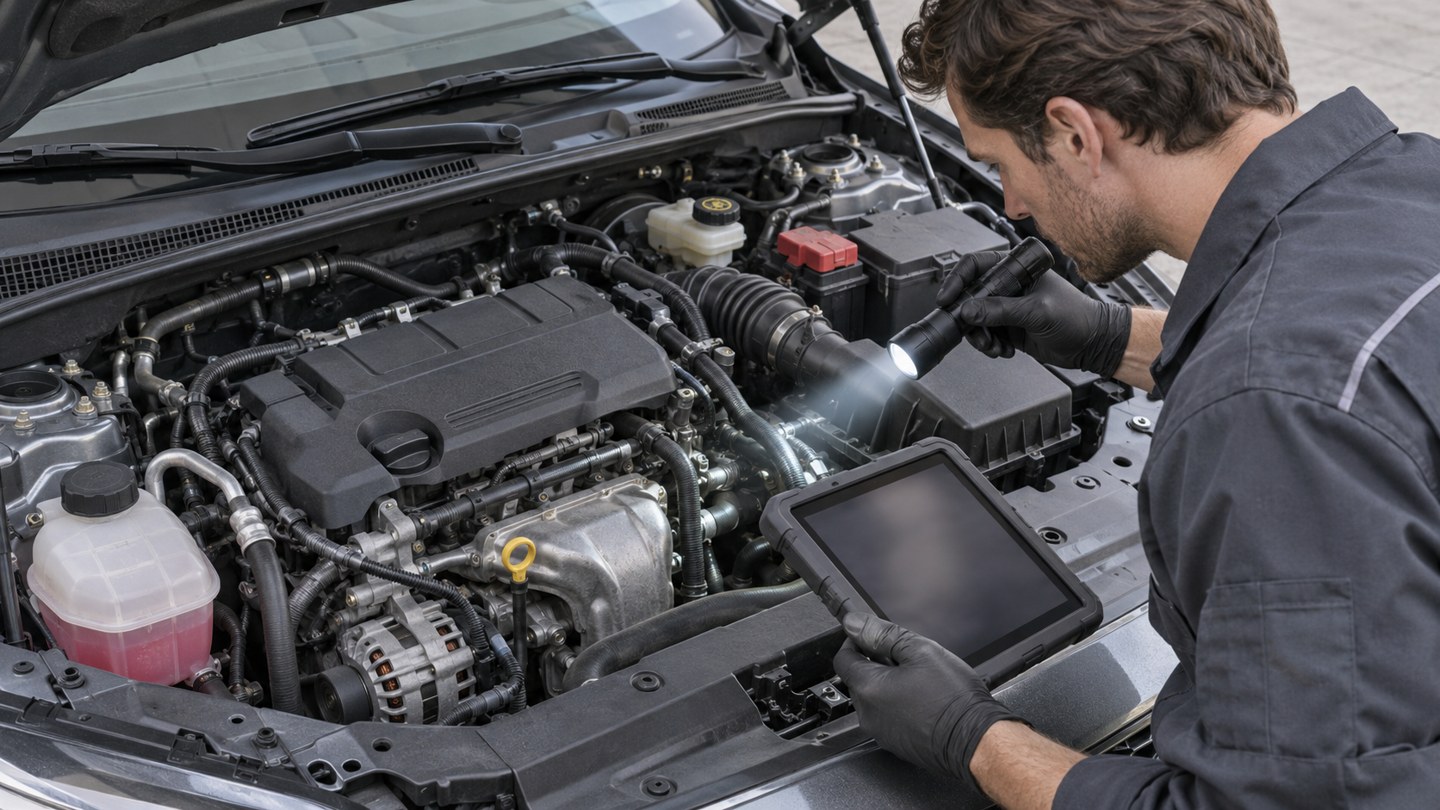
A technician should verify the temperature reading, coolant condition and level, leakage, circulation, radiator airflow, fan operation, thermostat behavior, and applicable fault data. Tests must follow the vehicle’s service instructions, especially for pressurized or electrically controlled cooling systems.
Start with verification, not part swapping
I would expect the workshop to compare the dashboard complaint with appropriate scan-tool values and physical evidence. Depending on the vehicle, the inspection may include fault codes, coolant pressure testing, controlled temperature measurements, fan command checks, and examination of hoses or expansion-tank connections. The correct method depends on the engine and its control system. A single fault code may identify a monitored circuit without proving the mechanical condition of a specific component.
The HELLA cooling-system diagnostic checklist describes checks for indicated temperature, radiator airflow, fan function, thermostat opening, radiator condition, pump operation, and pressure-control components. It reinforces why technicians should investigate the whole system before selecting replacement parts.
Check recent repair work carefully
A vehicle may overheat after a coolant change or repair if the system has not been filled or bled according to the correct procedure. A low coolant level can be the result of a leak or another underlying fault; topping up alone does not diagnose or resolve overheating. Modern cooling systems can use electrically driven pumps, additional circuits, and model-specific filling instructions. Adding coolant without following the proper method may not remove trapped air, and an incorrect coolant specification can create other problems.
If the engine has already experienced severe overheating, the workshop may need to inspect for consequences such as a damaged head gasket or other engine damage. Those checks affect the repair scope. The parts request should not be finalized as a routine thermostat replacement while there are signs of broader engine damage.
I would ask the workshop to identify the confirmed failure, the part number or catalog reference, and whether the problem involves an adjacent component. This gives a supplier a clear purchase request instead of a vague complaint such as “BMW overheating.”
How Do Water Pumps, Thermostats, and Coolant Leaks Differ?
These faults all appear under the cooling-system heading. Treating them as interchangeable can lead to a technically correct-looking quotation for the wrong repair.
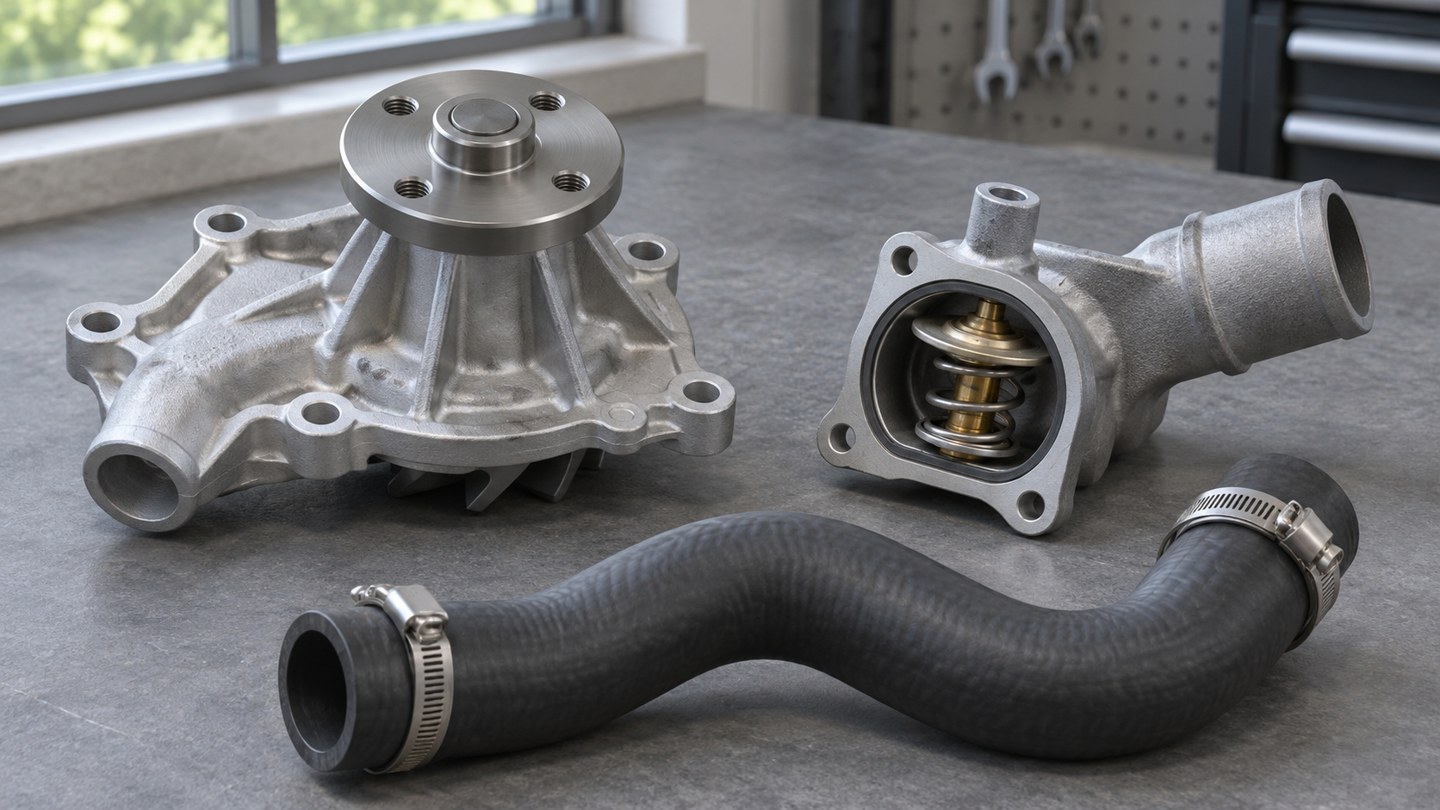
A water pump helps move coolant, a thermostat regulates its routing, and a leak allows coolant to escape. They may share symptoms, but they require different inspection methods, OE references, and replacement components. A fault in one does not automatically prove failure in the others.
The component determines the parts list
A water pump may be mechanical or electric and may have different electrical and hydraulic interfaces. A thermostat may be a replaceable insert or part of an integrated housing, with or without electronic control. A leak could originate at a hose connection, radiator, expansion tank, seal, or other point in the circuit. It would be risky to offer all three under one vague “cooling repair kit” unless the vehicle and repair scope actually support that package.
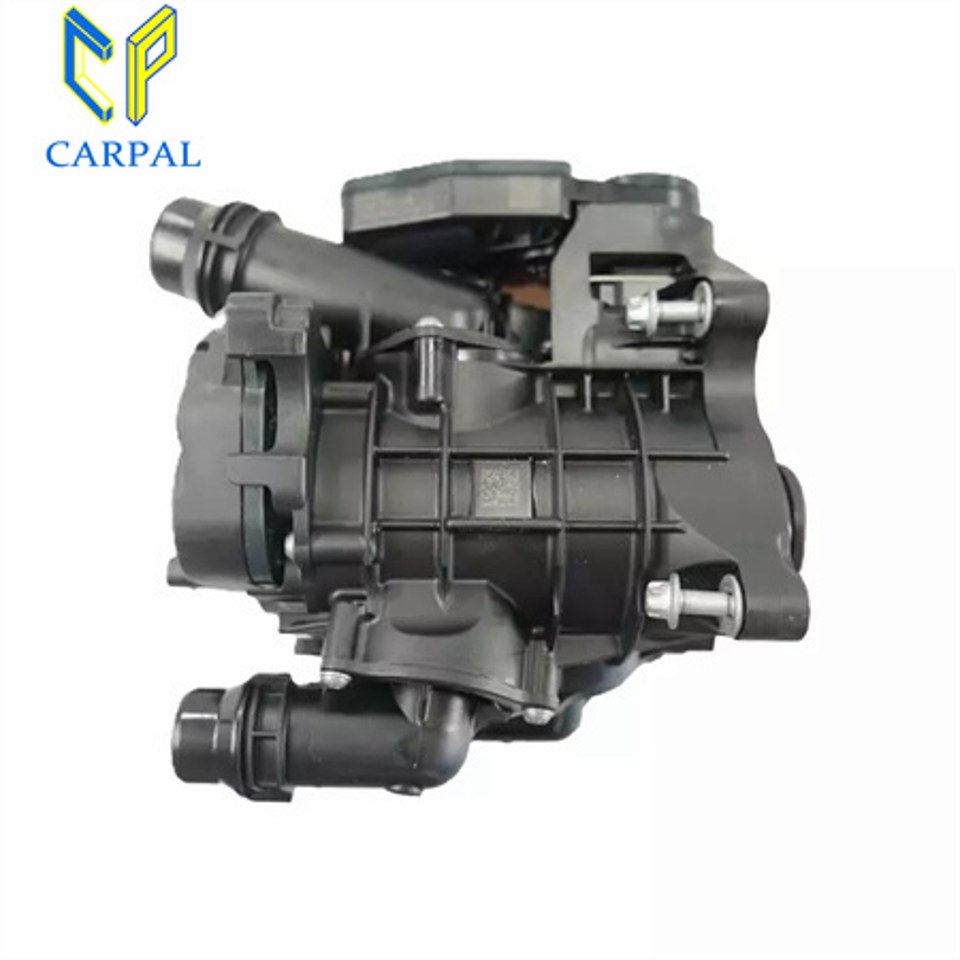
Carpal’s water pump and thermostat category lists relevant cooling-system products. One published example is a BMW B48 thermostat under reference 11538642560. It is useful as an example of an OE-based product listing, not evidence that this part fixes every overheating problem or fits every B48 vehicle.
The buyer should avoid using an unconfirmed cross-reference as a shortcut. Even when two products are described under the same engine family, their housing configuration, connectors, production range, and service role may differ.
Plan related repairs only with evidence
Sometimes the technician recommends replacing an associated seal, hose, or pump during another cooling repair because it is damaged or the vehicle procedure requires it. That can make sense. But a parts distributor should not advertise automatic replacement of every nearby component as essential. The mechanic’s assessment and manufacturer procedure must determine the work.
When a workshop reports an overheating repair, I would request a confirmed component-level diagnosis plus the OE reference and quantity. This makes the order easier to check and makes later warranty discussions more specific.
How Do You Choose the Right Cooling Part for a European Car?
A familiar model badge is not a complete fitment description. The same vehicle family can contain different engine and cooling-system layouts.
Use a verified OE reference, VIN or full vehicle data, engine variant, production date, component location, and connection details. Check the supplied assembly against the exact application rather than relying on general model names or similar product photos.
Build a structured application record
I would collect the make, model, chassis or platform code, engine code, production date, and VIN when available. Then I would record the suspected component and the verified original part reference. If the customer does not know the original reference, the supplier must confirm the application with reliable catalog data before offering an interchange option.
Different vehicle configurations may require a different pump connector, hose outlet, thermostat housing, or installation position. A visual match may be a useful early clue, but it is not the same as a fitment guarantee. For electrically controlled components, connector shape alone does not verify all electrical and control specifications.
| Buyer-supplied field | What it helps confirm |
|---|---|
| OE number or verified catalog reference | Exact component family and potential supersessions |
| VIN / model / chassis | Specific application rather than broad vehicle name |
| Engine and production details | Cooling-layout changes and variant differences |
| Location and connection photos | Mounting ports, hoses, sensors, or electrical connectors |
| Fault and repair scope | Which part needs replacement and what else is required |
| Order quantity and destination | Appropriate quotation and delivery planning |
Use catalog examples carefully
Carpal also offers a product catalog and inquiry page. I would use these as starting points to request a verified part and commercial quotation. A category page may show a product line, but it does not establish live stock, current lead time, or universal vehicle fitment.
An importer handling Mercedes-Benz, BMW, Audi, Volkswagen, and other European makes should keep application data with each SKU. A reliable purchase record should travel from the supplier’s quotation to the warehouse and later resale listing without losing the OE or fitment details.
What Should Wholesalers Do to Reduce Cooling-Parts Returns?
A rushed order can solve one workshop’s stock shortage but create a different problem at installation. Wrong connectors and incomplete kits are expensive across repeated orders.
Wholesalers should order from a confirmed diagnosis and a SKU-level parts list. They should check OE references, vehicle fitment, assembly contents, quality documentation, stock, MOQ, packaging, delivery terms, and warranty procedures before approving shipment.

Match diagnosis, part, and shipment
I recommend a straightforward three-part check. First, confirm the failed function: leakage, coolant circulation, flow control, airflow, or another cause. Second, verify the replacement against the vehicle and its original reference. Third, confirm the commercial package: how many units, what hardware or seals are included, and how each item will be labeled and shipped.
This approach helps the importer answer a workshop’s practical questions. Will the item fit the correct engine? Is it a pump or a thermostat assembly? Does the kit include the sealing component required by the chosen repair? Can the supplier provide information that supports the buyer’s own product listing and future replenishment?
Keep commercial claims specific
Stock availability, MOQ, lead time, and warranty treatment can vary by part number. I would not publish a blanket promise for all cooling components based on a general company brochure. Instead, buyers should send their OE-based lists and ask Carpal to confirm the current offer for each line.
A structured quotation also keeps consumer repair advice separate from wholesale sourcing. The driver needs a safe diagnosis and repair. The distributor needs accurate fitment, a clear bill of materials, and dependable documentation. Content that explains both processes can attract readers at different stages without turning an overheating guide into an unsupported sales pitch.
Conclusion
Overheating requires safe action and diagnosis before parts replacement. Confirm the failed cooling function, OE reference, and vehicle application before ordering the repair components.